I had a Sunnyvale host text me last Tuesday. She'd just gotten a notice from the city: her STR registration was being reviewed because the data Airbnb was now sending to Sunnyvale showed booking patterns that didn't match what she'd put on her permit application. She wasn't doing anything sneaky. She just hadn't realized the city now sees the same data she does.
This is what SB 346 in practice looks like. I covered the SB 346 data-sharing law in detail when it took effect. Five months in, the South Bay enforcement pattern has shifted enough that hosts are restructuring their listings.
The pivot most of my clients are making: shifting some or all of their inventory from short-term (sub-30-day) to mid-term (30+ day) rentals. Not because the math is automatically better. Because mid-term sits outside most of the rules SB 346 enables cities to enforce, and the demand is real this year.
Here's what's actually happening, what works, and where the trade-offs are.
Why MTR sits in a softer regulatory zone
California's STR rules, and the local ordinances they enable, almost universally trigger at the 30-day threshold. A booking of 29 days is regulated as a short-term rental: TOT (transient occupancy tax) collection, business license, registration, occupancy caps, neighbor notification rules, the works. A booking of 31 days isn't.
Most South Bay cities follow this pattern. San Jose, Sunnyvale, Mountain View, Cupertino, Santa Clara, Campbell, and Los Gatos all use 30 days as the line. There are nuances around cap counts (San Jose has its hosted vs. unhosted distinction), tax thresholds (some cities tax stays under 31 days, some under 90), and SB 346 data-sharing applies primarily to the platform-mediated short-term inventory.
So when a host shifts a unit from 5-night stays to 35-day stays, three things happen. The city's enforcement lens softens, or at least changes. The platform-shared data becomes less granular. And the unit moves into a different demand market: corporate housing, traveling medical professionals, relocating tech workers, displaced homeowners during remodels.
That last point is the real reason this is working in 2026. The demand is here.
Who's actually booking 30+ day stays in the South Bay
Three buckets are filling MTR inventory this spring.
Tech relocations. The summer 2026 cohort is huge. H-1B FY2027 selections, summer interns, returning new grads, RTO mandates. South Bay STR hosts can capture a meaningful share if they can offer 60-90 day stays.
Medical travelers. Stanford, El Camino Health, Kaiser, and the San Jose hospital network rotate traveling nurses and locum physicians on 13-week (91-day) contracts. The pricing isn't STR-premium, but the booking is solid and predictable.
Homeowners in remodel. Bay Area construction is slow and getting slower. Owners doing major remodels are commonly out of their primary residence for 4-8 months and looking for furnished mid-term rentals during the work. This is also the cleanest way to cover the January and February trough, which is the softest stretch of the South Bay year.
The fourth bucket, what people typically call "digital nomads," doesn't show up in the South Bay numbers. They book Tahoe, Joshua Tree, and Sea Ranch. Not Sunnyvale.
The pricing math (this is where hosts get burned)
Long-term rents have climbed since I wrote this, which changes the comparison. The updated STR-versus-lease math has the current numbers.
The trap I see most often: a host swaps a $290/night STR (averaging $220 effective after weekends, weekdays, vacancy, fees) for a $4,800/month MTR. They feel like they got a similar number. They didn't.
$220/night effective × 30 nights = $6,600/month. The MTR at $4,800 is a 27% revenue cut.
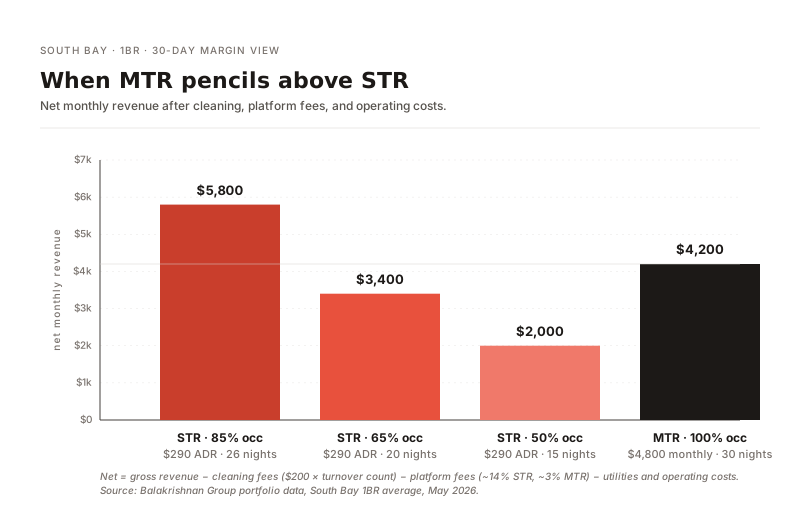
Where the MTR pencil works:
When occupancy on the STR side is below 65%. If the unit is sitting empty 12+ nights a month, the MTR's lower nightly equivalent at 100% occupancy can match or beat the STR.
When STR operating costs are eating margins. Cleaning fees on STR turnover are $150-280 per turn in the South Bay. A unit doing 8 turns/month is bleeding $1,200-2,200 in cleaning that an MTR doesn't incur (one move-in clean, one move-out clean, period). The tax treatment also shifts. STR is Schedule E if you provide substantial services; MTR is generally rental real estate income, with different deduction rules.
When the host is over capacity and burning out. Six STR turnovers a week vs. one MTR check-in every 2-3 months is a quality of life difference. The access tech also gets simpler at the MTR end of the spectrum — a single PIN that lives for 30+ days vs. a fresh PIN every 3-5 days. I covered the smart lock comparison across my portfolio separately. I have hosts who took a 15% revenue cut to move to MTR and called it the best business decision they made.
Where MTR doesn't pencil:
When the unit is in a high-end conference market. A two-bedroom Mountain View unit clearing 80% occupancy at $340/night ADR during conference season is grossing $8,160/month. The MTR equivalent in May 2026 is $5,500-6,800. That's a 20-32% cut, and it's structural — the MTR market doesn't pay conference premium. (For mixed STR/MTR hosts who want to capture both, the dynamic pricing tool comparison covers which platforms actually price the 28+ day discount automatically — PriceLabs handles it best.)
When the unit's geography is built for short stays. Beach and wine country are STR-native. The South Bay isn't, which is why MTR makes more sense here than in Half Moon Bay.
Platform mechanics
Most MTR bookings don't come through Airbnb or Vrbo, even though both list 30+ day stays. The dominant channels in 2026:
Furnished Finder. Built specifically for traveling nurses and medical professionals. Direct-booking platform, lower fees, predictable bookings.
Blueground (and similar tech-employer-direct providers). They've absorbed a meaningful share of corporate inventory in the past 2-3 years. Higher quality bar, more vetting, but stable fill rates.
Airbnb's Long-Term Stays filter. About 20-30% of MTR bookings still come through Airbnb because tenants discover the listing there even when the host's strategy isn't STR-first. The Airbnb 30-day discount setting matters more than most hosts realize.
Direct booking and word-of-mouth. Real estate agents whose clients are doing remodels. HR mobility teams at the bigger tech companies. Once you've done two or three placements through a relocation manager, you become a phone number on her list.
Most successful MTR operators are multi-channel: at least 3 platforms, with direct booking as the high-margin channel.
The lease language matters more than people think
A 35-day Airbnb booking under the platform's terms is one thing. A 90-day private booking is another. Once you're past 30 days, several California tenant protections start to apply, and once you're past 30 days under non-platform terms, you're often in standard residential lease territory.
What I write into MTR leases this year:
A clearly defined occupancy term (a date-bounded lease, not an open-ended rental).
Specific clauses about the furnished status and the host's right to access for maintenance.
A move-out condition checklist with the same specificity as a long-term lease.
Renters insurance requirements (some hosts skip this on STR; you shouldn't on MTR). The AirCover gaps discussion has parallels here — the platform-level coverage you get on a 5-night booking isn't the same as what you have on a 60-day stay, and the host's own policy matters more.
Utility and Wi-Fi handling (the host typically pays utilities and Wi-Fi on MTR; the lease should specify usage caps to avoid surprise PG&E bills if a tenant runs a 5-bedroom AC during a heat dome).
For 90+ day stays, I sometimes recommend talking to a real estate attorney about the lease structure. The line between "furnished extended stay" and "residential tenancy" gets fuzzy past 90 days, and the protections that flip on can be material.
What I tell hosts considering the pivot
If your STR occupancy is above 75% and your ADR is north of $280, don't pivot. The math doesn't work yet, and the regulatory pressure isn't crushing for high-performing hosts.
If your STR occupancy is below 65%, run the math seriously. Pull your last 90 days of bookings, calculate effective nightly rate, and compare to MTR comps in your zip code.
If your STR is in unincorporated Santa Clara County, or in a city with cap-and-quota rules where you're past the cap, MTR is the path forward whether you want it or not.
If you have multiple units, the right answer is usually mixed: keep one or two on the STR side for conference season and high-margin weekends, shift the rest to MTR for stable base load. I've helped hosts restructure portfolios into 70/30 MTR/STR splits, and the operational load drop alone is worth the revenue trade.
The hosts I'd watch closest right now are the ones still running pure-STR operations on units that consistently miss 65% occupancy. SB 346 means the cities now know. The cap discussions in Mountain View and Sunnyvale that have been quiet for 18 months are about to get loud again. Better to pivot on your timeline than the city's.
If you're trying to figure out whether the MTR pivot makes sense for your specific South Bay property, request a free rental analysis and I'll model the actual numbers — STR vs. MTR vs. mixed — based on your unit's location, size, and current performance. Or call me at (408) 813-8001.
Sources
- California SB 346 — California Legislative Information
- California Civil Code: Residential Tenancies — California Legislative Information
- San Jose Short-Term Rental Regulations — City of San Jose
- Sunnyvale Short-Term Rental Permits — City of Sunnyvale
- Mountain View Short-Term Rental Ordinance — City of Mountain View
- Furnished Finder — Furnished Finder
Ready to optimize your property?
Get a professional evaluation of your property's STR revenue potential, completely free.
Start Partnership